
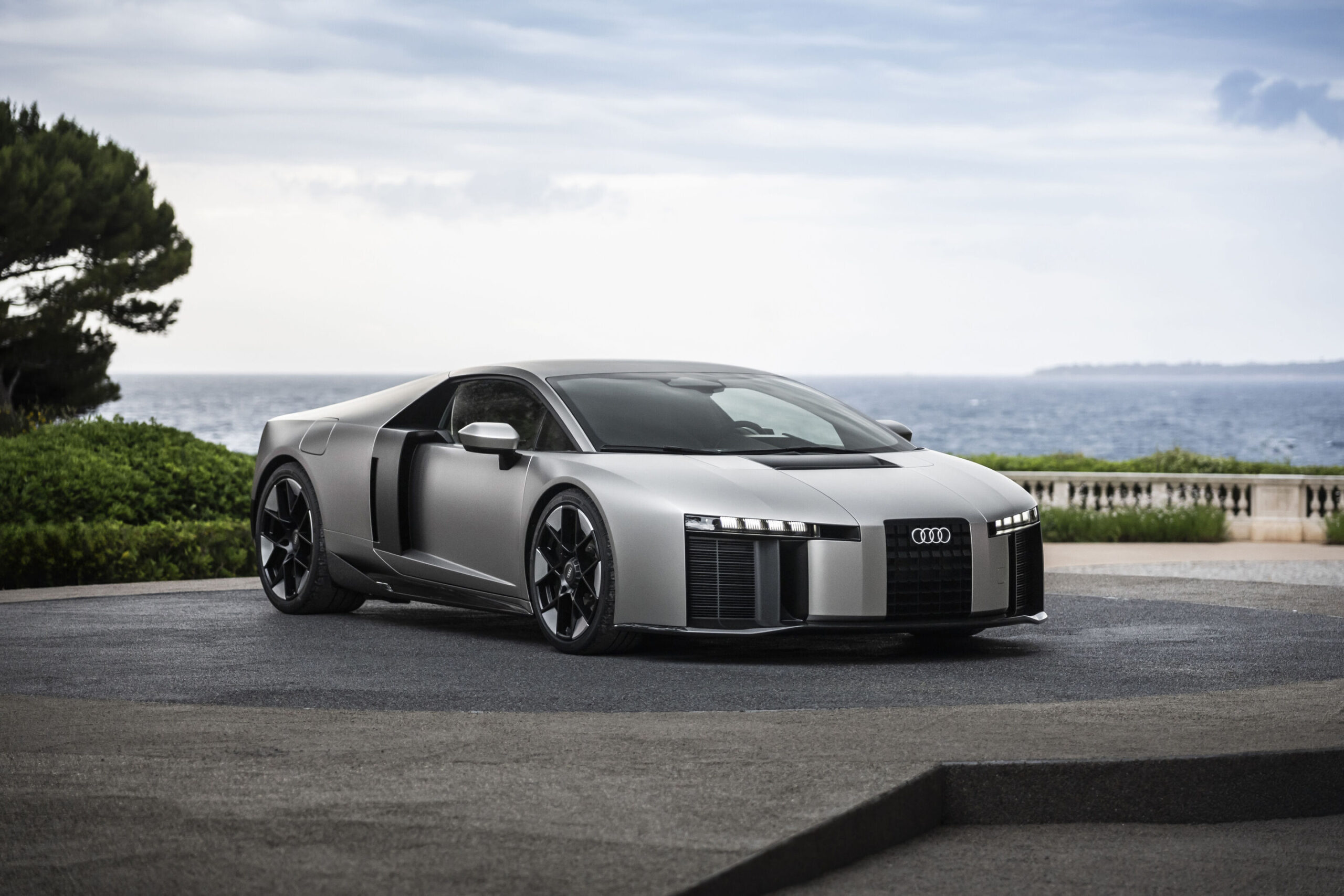
With the Nuvolari, Audi is unveiling its first supercar with a high-performance hybrid powertrain — further accelerating technological progress. With 1,001 PS and a top speed of more than 350 km/h, the Nuvolari is set to become the most powerful vehicle and the fastest production vehicle in the history of the four rings..
The Audi Nuvolari stands for uncompromising performance and absolute focus, named after Tazio Nuvolari, one of the most prominent figures in motorsport history. Born in Italy, he was known for his fearlessness, ingenuity, dedication, and a single-minded will to succeed.
The Audi Nuvolari will combine the high-performance character of a supercar with a distinctive design. Taut surfaces, seamlessly integrated technology, and intelligent aerodynamics define its appearance. The mid‑engine layout defines the proportions, resulting in a monolithic volume, a powerful stance, and a strong presence.
The exterior is characterized by Audi’s new signature colour Titanium, a paint also used on the Audi Concept C and the Audi Formula 1 race car. In combination with carbon elements, it highlights the precise lines of the Nuvolari.
The Audi Nuvolaria accelerates from 0 to 100 km/h in 2.6 seconds and reaches 200 km/h in 6.8 seconds. These figures are enabled by a range of innovations inspired by Formula 1, including the high-performance hybrid powertrain, quattro predictive ride, active aerodynamics, and the new Audi Space Frame (ASF) with carbon exterior.

Powered by a hybrid high-performance powertrain with a maximum system output of 736 kW (1,001 PS). It combines a 4.0-liter V8 biturbo engine delivering 588 kW (800 hp) with three axial flux electric motors, each producing 110 kW. The lithium-ion battery has a gross capacity of 7.3 kWh. The combustion engine delivers a maximum torque of 730 Nm and reaches up to 10,000 rpm — a range previously reserved for motorsports.
Two oil-cooled axial flux electric motors at the front axle deliver up to 2,150 Nm of torque. As an integral part of the quattro system, they support variable torque distribution. A third electric motor between the V8 mid-engine and the transmission completes the drive concept.
The quattro drive is one of Audi’s defining innovations and stands for traction, control, and driving dynamics in all conditions. In the Nuvolari, Audi further develops this principle and defines the next generation of all-wheel drive with the quattro predictive ride. The system processes the current driving state based on a highly precise vehicle state model. Detailed sensor data — including steering angle, acceleration, yaw rate (rotation of the vehicle around its vertical axis, which determines steering response in corners), and current grip level — continuously feed into the control system. If the system anticipates a potential loss of grip in a corner, it responds proactively as an integrated system.
The electric motors at the front axle are a key element of the predictive dynamics system, enabling variable torque vectoring for agile cornering and stability at high speeds.
Audi uses active aerodynamics in the Nuvolari to purposefully combine performance and efficiency. The system adjusts downforce, drag, and aerodynamic balance in response to driving conditions — ensuring maximum stability and precise vehicle control. Each exterior element serves a clearly defined aerodynamic function, from the front splitter to the rear diffuser. Audi’s Formula 1 drivers provided targeted feedback during the development phase to fine-tune aerodynamic performance.
Front air intakes ensure effective brake cooling as well as efficient thermal management of the combustion engine and hybrid components. A vented front end, known as an S‑duct, improves aerodynamic efficiency at the front axle — delivering additional downforce, reducing lift at high speeds, and improving cooling of the powertrain.

The central element of the active aerodynamic system is the deployable adaptive rear wing. It controls downforce and drag across three configurations: Closed, Low Downforce (LD), and High Downforce (HD).
In the Closed position, the rear wing is retracted to minimize drag and improve efficiency. In LD and HD configurations, different levels of downforce are generated depending on driving dynamics and the selected driving mode. In performance-oriented modes such as Dynamic, Dynamic+, and Track, the rear wing operates fully automatically. On straights, the system shifts to the LD position to optimize top speed and stability. The Drag Reduction System (DRS), familiar from Formula 1, can be activated manually via a dedicated steering‑wheel button to further lower the wing, reducing drag and increasing top speed.
Under braking and in corners, the wing moves to the HD position to optimize downforce for maximum performance and control. In this high-downforce configuration, the aerodynamic concept of the Audi Nuvolari— depending on the driving situation — delivers more than 400 kg of downforce.The rear wing position can be controlled both automatically and manually via a rotary control on the steering wheel — in all driving modes except E‑Hybrid.
Deliveries of the supercar, limited to 499 units, will begin in the first half of 2027 and while Audi has not unveiled a price point as yet expect prices to start from £500,000