
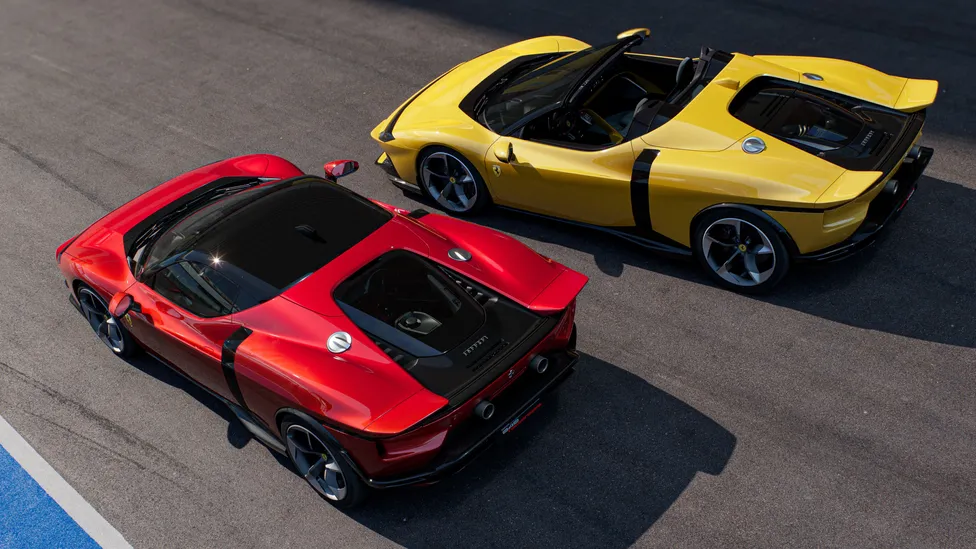
Ferrari has unveiled its latest sports car, the 849 Testarossa. The car, which replaces the SF90 Stradale in the range, is a hybrid plug-in super sports berlinetta equipped with three electric motors alongside the mid-rear twin-turbo V8, delivering a total of 1050 cv, 50 more than the car it replaces..
The 849 Testarossa takes its place at the top of Ferrari’s range thanks to its performance, its ability to thrill the driver without ever compromising ride comfort or interior refinement, as well as its futuristic yet deeply historically rooted design. This car is conceived for the most demanding clients; those who want the very best from a Ferrari. It is also the reason for the return of a legendary name in Maranello’s history, Testa Rossa, which was first used on the 500 TR in 1956 to describe the colour of the cam covers of some of Ferrari’s most extreme, high-performance and iconic racing engines, before being used as a name for one of the marque’s most famous road-going models, the 1984 Testarossa.
The heart of the 849 Testarossa revolves around its twin-turbo eight-cylinder internal combustion engine, part of the family of engines that received multiple International Engine of the Year awards. The unit has been completely re-engineered to reach new performance peaks (a remarkable 830 cv of maximum power) and is combined with an advanced hybrid system derived from Ferrari’s unmatched motorsport experience. Among the most prominent innovations is the new turbo, the largest ever for a Ferrari production car, enabling unprecedented acceleration. The hybrid group, consisting of a rear electric motor and two units installed on the front axle, is capable of delivering 220 cv. The on-demand four-wheel drive system and torque vectoring maximize performance in all conditions.

To enhance its dynamic qualities and the driver feedback at the limit, the 849 Testarossa is equipped (in addition to the latest generation brake-by-wire system) with Ferrari’s ABS Evo controller, which improves braking precision and consistency in all conditions, along with the new braking system. The spring and damper set-up has been completely revised for improved behaviour at the limit of grip. Extensive component weight reduction has allowed the 849 Testarossa to boast the best power-to-weight ratio ever for a range model, since the enormous performance increase has not resulted in any additional weight compared to the SF90 Stradale.
From a styling point of view as well, the 849 Testarossa marks a revolution in the concept of a Ferrari V8 mid-rear berlinetta: the inspiration taken from 1970s Sports Prototypes, together with sharp and geometric lines, creates a unique and timeless design. The synergy between form and function has enabled impressive aerodynamic performance: the total downforce of 415 kg at 250 km/h represents a 25 kg increase over the SF90 Stradale as well as providing a 15% boost in cooling power for the powertrain and brakes.
The cockpit is even more enveloping and ergonomic than before: the central sail motif with the integrated gear-change gate, inspired by the F80, improves the positioning of components and makes them more accessible. The new steering wheel, equipped with mechanical buttons (including the iconic engine start button), elevates the driving experience while maintaining the high functionality of the latest-generation Ferrari steering wheels. Finally, a new HMI system makes interaction with the car even simpler and more intuitive.
ELECTRIC MOTORS AND HYBRID SYSTEM
The 849 Testarossa adopts a PHEV architecture derived from the SF90 Stradale, combining the V8 internal combustion engine with three electric motors for a total power of 220 hp. Two of them are located on the front axle and make up the RAC-e (electronic cornering set-up regulator) system which enables the 4WD system and torque vectoring to maximise traction and efficiency when exiting corners. The third electric motor, the MGU-K (Motor Generator Unit, Kinetic), is positioned on the rear axle and derives directly from the Scuderia’s experience in Formula 1.

The entire system has been revised to improve performance and driving comfort, with an optimised calibration to work in synergy with the internal-combustion engine. The control system also integrates a new active damping function aimed at regularizing the engine idle, improving the transition between the thermal and electrical operating phases. The cooling maps of the electric motors have been optimised, ensuring a higher thermal efficiency of 10-12 °C. This keeps the electric performance consistent for a longer period, even under conditions of intensive use.
The regeneration strategy under braking has been revised to improve pedal feel even more, making pedal travel even smoother and more effective. The regenerative intervention is more progressive and natural, further improving the consistency between electrical and hydraulic deceleration. The battery and electric motor management strategies are calibrated according to the four electric driving modes that can be selected via the eManettino — eDrive, Hybrid, Performance and Qualify — optimising performance in all conditions. In eDrive mode, the car can travel up to 25 km in electric drive only thanks to the 7.45 kWh lithium-ion battery which is installed in the chassis to ensure a low centre of gravity and optimal weight balance.
AERODYNAMICS
The main objectives of the 849 Testarossa’s aerodynamic design were to optimise thermal performance and increase downforce, drawing inspiration and reference from historical and contemporary racing solutions, such as those seen on the 512 S, the 512 M and the FXX-K. The 849 Testarossa generates a total load of 415 kg at 250 km/h, an increase of 25 kg compared to the SF90 Stradale, while cooling performance improves by 15%.
The volume of the bodywork flanks has been optimised to increase the amount of air flowing to the intercoolers by 30%. A channel has been scooped out in the door to feed the lower portion of the intercooler, while the lower surface of the duct is equipped with a blow that allows the boundary layer to be captured. The side air intake trim wraps around the bodywork up to the sill cover and has a profiled shape with an upper auxiliary inlet to maximise the air flow to the radiating masses. The side inlet, in addition to the intercooler, also feeds the rear brake duct and the engine intake.

The front underfloor, responsible for 35% of the total downforce, has been completely redesigned: three pairs of cascading vortex generators maximise outwash and intake, guaranteeing a 20% increase in downforce compared to the SF90 Stradale. The excavation upstream of the side louvres and the relative nolder contribute to the extraction of the hot flow from the front compartment and reduce the compression on the front face of the tyre, decreasing drag.
The squarer front bumper has integrated bumperettes that help increase the airflow to the front air intakes and generate vorticity useful for extracting the flow from the wheel arch. The splitter (also larger in size) incorporates a flick, inspired by the SF90 XX Stradale, responsible for 10% of the front downforce.
The rear adopts a twin-tail architecture inspired by the 512 S, with two wing sections (called twin tail) that exploit the high-energy flow that laps the top of the muscular rear wheelarches to generate 10% of the downforce at the rear. The active rear spoiler, derived from that of the SF90 Stradale and the 296 GTB, is integrated into the bodywork and actioned by a kinematic solution that is 2 kg lighter. It is capable of switching between Low Drag and High Downforce configurations in less than a second. In High Downforce configuration, it helps to generate up to 100 kg of downforce at 250 km/h, working in synergy with the passive elements of the tail.

The rear underbody adopts a multi-level diffuser with a suspended lower element and vertical fences that allow the wheel wake to be isolated. A pair of vortex generators with an oversized chord maximizes expansion at the height of the rear axle. The downforce generated by the rear underfloor is aligned with that of the SF90 Stradale, with a 10% reduction in drag.
EXTERIOR
The 849 Testarossa was developed by the Ferrari Styling Centre, directed by Flavio Manzoni, revolutionising the shape of the SF90 Stradale and emphasising the car’s technological and performance characteristics. The stylistic language develops an architectural and futuristic direction, with a balance between sculptural forms and graphic elements. The vertical and transverse lines generate an unprecedented visual scheme, inspired by aeronautics and the Sports Prototypes of the 1970s.
The flank is dominated by the door with a three-dimensional modelling which starts from the main crease line. The deeply sculpted upper surface of the door has a complex three-dimensionality never before achieved on a standard production car and redefines the relationship between the car body and the cabin area. The panel is made of a single aluminium alloy moulding thanks to Ferrari’s advanced manufacturing processes.

The characteristic of the door design is the way it is employed as an aerodynamic duct, giving it a distinctive momentum and architecture. The contrasting black vertical side intake feeds air to the intercooler and incorporates an additional intake, reinforcing the architectural imprint and introducing the concept of three-dimensional livery. The crease line extends towards the rear, leading to a double tail design inspired by the 512 S that changes the visual perception of the cabin, making it more compact and giving it a more cab-forward design.
The front has structured volumes that recall Ferrari geometries from the 1980s. A bridge-like horizontal fascia connects the headlights, recalling the styling theme already used on the Ferrari 12Cilindri and F80. This element creates a new ratio between volumes and voids in the surface treatment which creates a full-width spoiler effect. The body-coloured flicks and the black splitter complete the lower area of the bumper, reinforcing the technical and aerodynamic characteristics.
The rear is dominated by the two tails inspired by the 512 S which, integrated with the active wing, compose a patented aerodynamic solution. The sculpted rear bumper underlines the car’s sporty stance, emphasising the width, while the central section is characterized by the modelling around the iconic round tailpipes. The tail is completed by a full-width diffuser, which is very pronounced in the centre, and which enhances the sense of extreme performance.
In plan view, the extremely clean compositional form of the car is visible. The flicks that protrude from the front bumper, together with the two rear tail sections, harmoniously define the perimeter of the car. The rear screen is visually integrated into the two tail sections, again underlining the cab-forward effect.

The forged wheels have been developed in close synergy with the aerodynamics department. Prominent aerodynamic profiles with extended diamond-cut treatment optimise air extraction from the wheel well and control wake. The geometries allow for extensive aesthetic and functional customization.
INTERIOR
The interior of the 849 Testarossa is a synthesis between the layout of a berlinetta with a horizontal dashboard and the cockpit of a single-seater. The upper body of the dashboard features a floating effect with ‘C’-shaped air vents framed in aluminium. Between the upper and lower parts there is a contrasting horizontal band that integrates the main controls and the passenger screen. The lower part of the dash is characterized by two architectural sail motifs that incorporate the control functions, with the F80-inspired gate integrated in a floating position in the sail on the steering wheel side.
The central tunnel layout has been redesigned to distribute the secondary commands in a more rational and minimalist way. The central sail theme is picked up on the door cards where it houses a woofer with an aluminium grille. The same element also houses the door pull.
The interior design sets out to optimise space and improve ergonomics. Accessibility has been improved by reducing the width of the bottom of the door panel and adjacent areas, thus freeing up additional space for the rear bench and the passenger-side glove box.
The seats are available in two versions: comfort, with a sculptural treatment of the upholstery and styling that matches the geometry of the cockpit, and a carbon-fibre racing seat, with sporty side bolsters for ideal lateral containment. Both versions are the result of a combined study of ergonomics and style.
PERSONALISATION OPTIONS
The 849 Testarossa offers a wide range of personalisation options designed to enhance the car’s sporty character and stylistic identity. Among the most significant innovations are two new colours developed specifically for the occasion: Rosso Fiammante, a technological evolution of the historic pastel Rosso Corsa shade enriched by a metallic effect obtained through a process that gives warm and brilliant reflections under sunlight; and Giallo Ambra, an intense and warm shade with reddish hues, inspired by the depth and chromatic richness of natural amber.

For the interior, a new Alcantara trim called Giallo Siena has been introduced, designed to harmonise with the Giallo Ambra exterior. This refined and sporty shade helps to create a modern and, at the same time, relaxing environment inside the cabin.
The forged rims, developed in close synergy with the aerodynamic department, are also customisable. The sophisticated geometries allow you to choose between different configurations, adapting the aesthetics to personal taste.
Prices start at 460,000 euros, or 500,000 euros for the Spider.